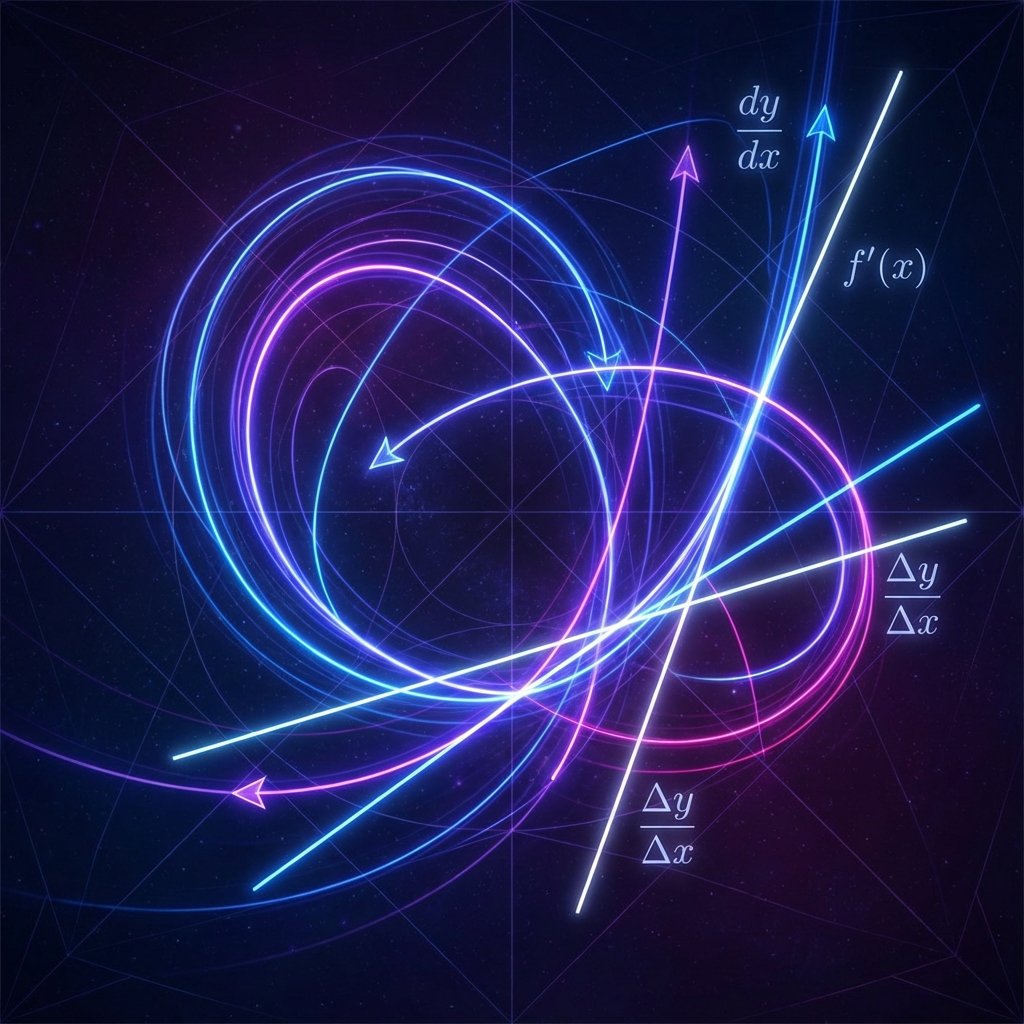
Calculus is often feared, but at its heart, it's just the study of change. A derivative simply tells you: "How fast is this thing changing right now?" Whether you're tracking the speed of a car or the growth of a population, derivatives give you the exact rate of change at any specific moment.
Think of a car's speedometer. Your average speed over a whole trip might be 60 km/h, but the speedometer shows your speed right now — that instantaneous reading is exactly what a derivative computes. Formally, the derivative is the limit of the average rate of change as the time interval shrinks to zero, but you rarely need the formal definition once you know the rules below.
1. The Power Rule (Your Best Friend)
This is the rule you'll use 90% of the time. If you have a variable raised to a power, you bring the power down in front and subtract one from the exponent.
Example:
If f(x) = x³, then f'(x) = 3x².
Why does this work? Imagine a square growing in size. The rate at which its area grows is related to its perimeter (2x). Imagine a cube growing; its volume grows related to its surface area (3x²). The math reflects physical reality.
2. The Chain Rule (The Onion Method)
What if you have a function inside another function, like (3x + 1)²? You peel it like an onion: take the derivative of the "outside" layer, then multiply it by the derivative of the "inside" layer.
Common Pitfall: Students often forget the multiplication step. They simply differentiate the outside and stop. Always remember: derivative of the outside TIMES derivative of the inside.
3. Worked Example: Step by Step
Let's differentiate f(x) = (2x³ + 5x)⁴ completely, showing every step.
- Identify the layers. The outside layer is u⁴ and the inside layer is u = 2x³ + 5x.
- Differentiate the outside. Using the power rule on u⁴ gives 4u³, which is 4(2x³ + 5x)³.
- Differentiate the inside. The derivative of 2x³ + 5x is 6x² + 5 (power rule applied to each term).
- Multiply the layers. f'(x) = 4(2x³ + 5x)³ · (6x² + 5).
That's the final answer. Notice how the chain rule and power rule work together — this combination covers the vast majority of derivatives you'll ever face on an exam. To check your work, evaluate both f'(x) and a numerical estimate at a point like x = 1: the slope of f near x = 1 should match 4(7)³ · 11 = 15,092.
4. Real World Applications
- Physics: Velocity is the derivative of position. Acceleration is the derivative of velocity.
- Economics: "Marginal Cost" is simply the derivative of the Cost function. It tells you how much it costs to produce one more item.
- Data Science: Gradient Descent, the algorithm that trains Neural Networks, uses derivatives to find the "downhill" direction of error.
Common Mistakes to Avoid
- Forgetting the inside derivative. Writing d/dx[(3x+1)²] = 2(3x+1) and stopping. The correct answer multiplies by the inside derivative 3, giving 6(3x+1).
- Misapplying the power rule to constants. The derivative of a constant like 7 is 0, not 7x⁻¹. Constants don't change, so their rate of change is zero.
- Treating products like sums. The derivative of f·g is NOT f'·g'. You need the product rule: f'g + fg'. This is one of the most common exam errors.
- Dropping negative exponents. For f(x) = 1/x = x⁻¹, the power rule gives f'(x) = −x⁻² = −1/x². Students frequently lose the minus sign.
Frequently Asked Questions
What does a derivative actually represent?
Geometrically, it's the slope of the tangent line to the curve at a point. Physically, it's the instantaneous rate of change — how fast the output changes when the input nudges slightly. Both interpretations are the same number.
When do I use the chain rule versus the product rule?
Use the chain rule when one function is inside another, like sin(x²) or (3x+1)⁵. Use the product rule when two functions are multiplied side by side, like x² · sin(x). Complicated expressions often need both.
Can every function be differentiated?
No. A function must be continuous and "smooth" at a point to have a derivative there. Sharp corners (like |x| at x = 0), jumps, and vertical tangents all break differentiability, even when the function itself is defined.