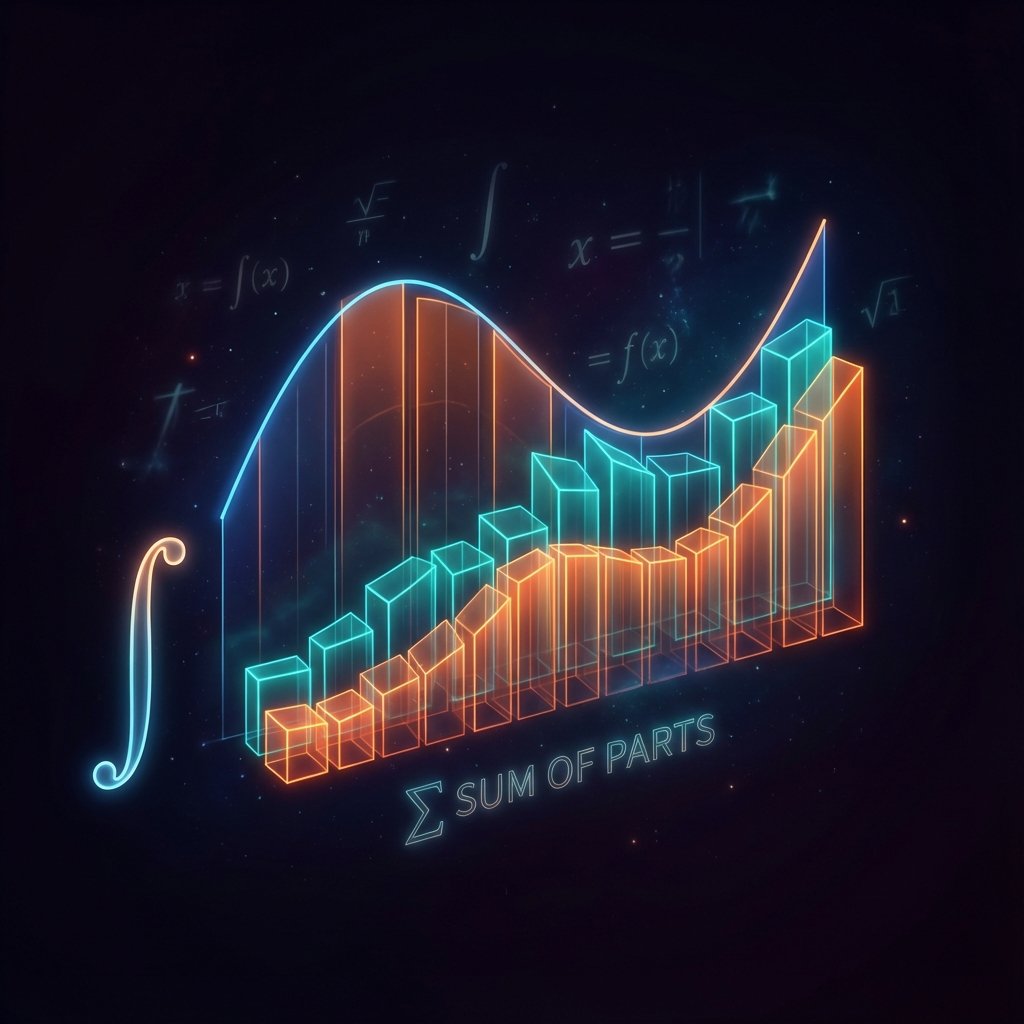
If differentiation is slicing, integration is gluing. Learn how to calculate areas and volumes.
Here's the intuition: to find the area under a curvy graph, chop the region into thousands of skinny rectangles, compute each tiny area, and add them all up. As the rectangles get infinitely thin, the sum becomes exact — that limiting process is the integral. The elongated "S" symbol (∫) literally stands for sum.
Definite vs. Indefinite
Indefinite Integrals give you a general formula (the anti-derivative). They essentially answer: "What function gave us this derivative?" Don't forget different constants could disappear during differentiation, so we always add + C.
Definite Integrals give you a specific number. They calculate the net signed area between the function and the x-axis over a specific interval [a, b].
The Fundamental Theorem of Calculus
This theorem links the two halves of calculus. It states that if you integrate a derivative, you get the original function back (plus a constant). It allows us to compute areas easily without using infinite sums: find any antiderivative F of your function, then the definite integral from a to b is simply F(b) − F(a).
Worked Example: Area Under a Parabola
Let's compute the exact area under f(x) = x² between x = 0 and x = 3.
- Find the antiderivative. Using the power rule for integration: ∫ x² dx = x³/3 + C.
- Evaluate at the upper limit. F(3) = 3³/3 = 27/3 = 9.
- Evaluate at the lower limit. F(0) = 0³/3 = 0.
- Subtract. Area = F(3) − F(0) = 9 − 0 = 9 square units.
Sanity check: the region fits inside a 3 × 9 rectangle (area 27), and a parabola encloses exactly one third of that bounding rectangle. One third of 27 is 9 — the answer checks out. Building the habit of estimating like this catches most arithmetic slips before they cost you marks.
Beyond the Power Rule
Once the power rule feels automatic, two techniques unlock nearly everything else. u-substitution is the chain rule in reverse: when you spot a function and its derivative living inside the same integral — like 2x sitting next to (x² + 1)⁵ — substitute u for the inner function and the integral collapses into a simple power rule problem. Integration by parts is the product rule in reverse, and it handles mixed products like x·eˣ or x·ln(x). Between the power rule, substitution, and parts, you can crack the overwhelming majority of integrals that appear on any first-year exam.
Applications
- Physics: Integrating velocity gives position. Integrating force over distance gives Work.
- Probability: In statistics, the area under the Probability Density Function curve represents the probability of an event occurring.
- Engineering: Calculating the center of mass or the moment of inertia for odd-shaped objects requires integration.
Common Mistakes to Avoid
- Forgetting + C on indefinite integrals. Every antiderivative has infinitely many siblings shifted up or down. Omitting the constant loses marks and breaks differential equation solutions.
- Applying the power rule to n = −1. The formula x^(n+1)/(n+1) explodes when n = −1 (division by zero). The integral of 1/x is ln|x| + C — a special case worth memorizing.
- Ignoring negative area. A definite integral counts area below the x-axis as negative. If a question asks for total geometric area, split the interval where the function crosses zero and add absolute values.
- Swapping the limits. Computing F(a) − F(b) instead of F(b) − F(a) flips the sign of your answer. Upper limit first, always.
Frequently Asked Questions
What's the real difference between an integral and an antiderivative?
An antiderivative is a function — any F whose derivative is f. A definite integral is a number — the net area over an interval. The Fundamental Theorem of Calculus is the bridge: you compute the number by evaluating the function at the endpoints.
Why does area below the x-axis count as negative?
Because the integral sums f(x) · dx, and f(x) is negative below the axis. This signed behavior is actually useful: integrating velocity that goes negative correctly shows an object moving backward, not gaining distance.
What if I can't find an antiderivative at all?
Some functions, like e^(−x²), have no elementary antiderivative. In those cases mathematicians and engineers use numerical methods — Simpson's rule, the trapezoid rule, or a calculator — to approximate the definite integral to any precision needed.