The Master Formula
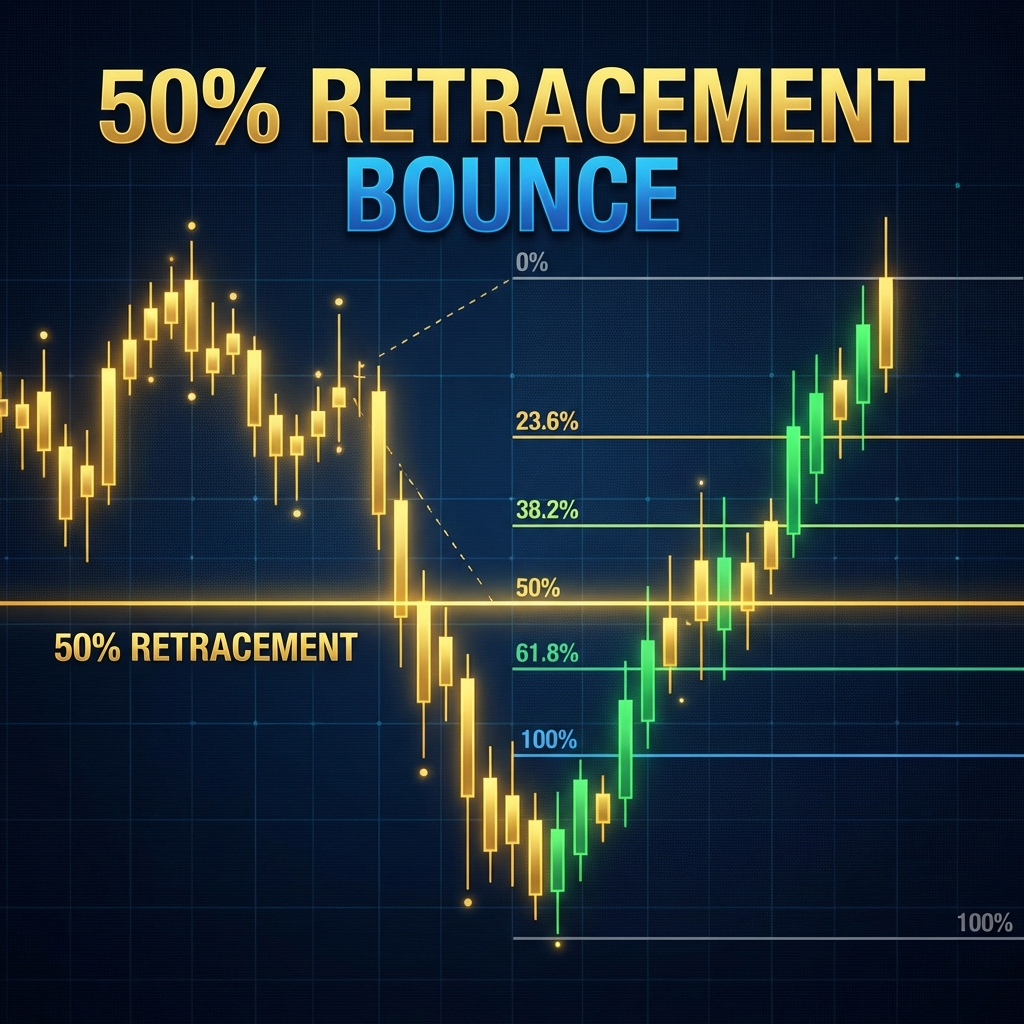
Golden Level (GL) = $\frac{Swing High + Swing Low}{2}$
Where:
- Swing High: The highest point of the current impulsive move.
- Swing Low: The origin point where the move began.
Dimensional Analysis: Price vs. Time
In Quant trading, we also look at the Time Equilibrium. If a move took 10 days to complete, the 50% time-reversion level is 5 days. Often, the most powerful trades occur at the Confluence of 50% Price and 50% Time. This is the "X marks the spot" for a high-probability reversal.
Variations: The 50% Rule in Short Selling
For a bearish move ($High \to Low$):$$Entry = Low + (High - Low) \times 0.5$$In a downtrend, you are looking to sell the "dead cat bounce" at the 50% level, expecting the price to create a Lower High.
Shortcuts & General Rules of Thumb
- The "One-Tick" Rule: Institutional orders are often clustered 1-2 ticks above the 50% level in a buy scenario. Don't be too greedy; front-run the exact midpoint slightly to ensure an entry.
- Trend Filter: Only trade the 50% bounce if the Higher Timeframe (Daily/Weekly) is in alignment with your direction.
- Mnemonic: "Buy the discount, sell the premium, stay at the medium."
Edge Cases: Gaps and Slippage
- Opening Gaps: If a stock gaps down through the 50% level at the market open, the level is invalidated. The "equilibrium" has shifted before the session even started.
- News Events: During FOMC or Earnings, technical levels are ignored. The 50% level becomes a "slippage zone" where stop losses might not be filled at your desired price.
- Low Liquidity: In "Penny Stocks" or low-volume altcoins, price often overshoots the 50% level significantly before reacting. Use wider stops in these environments.