1. The Reality Check
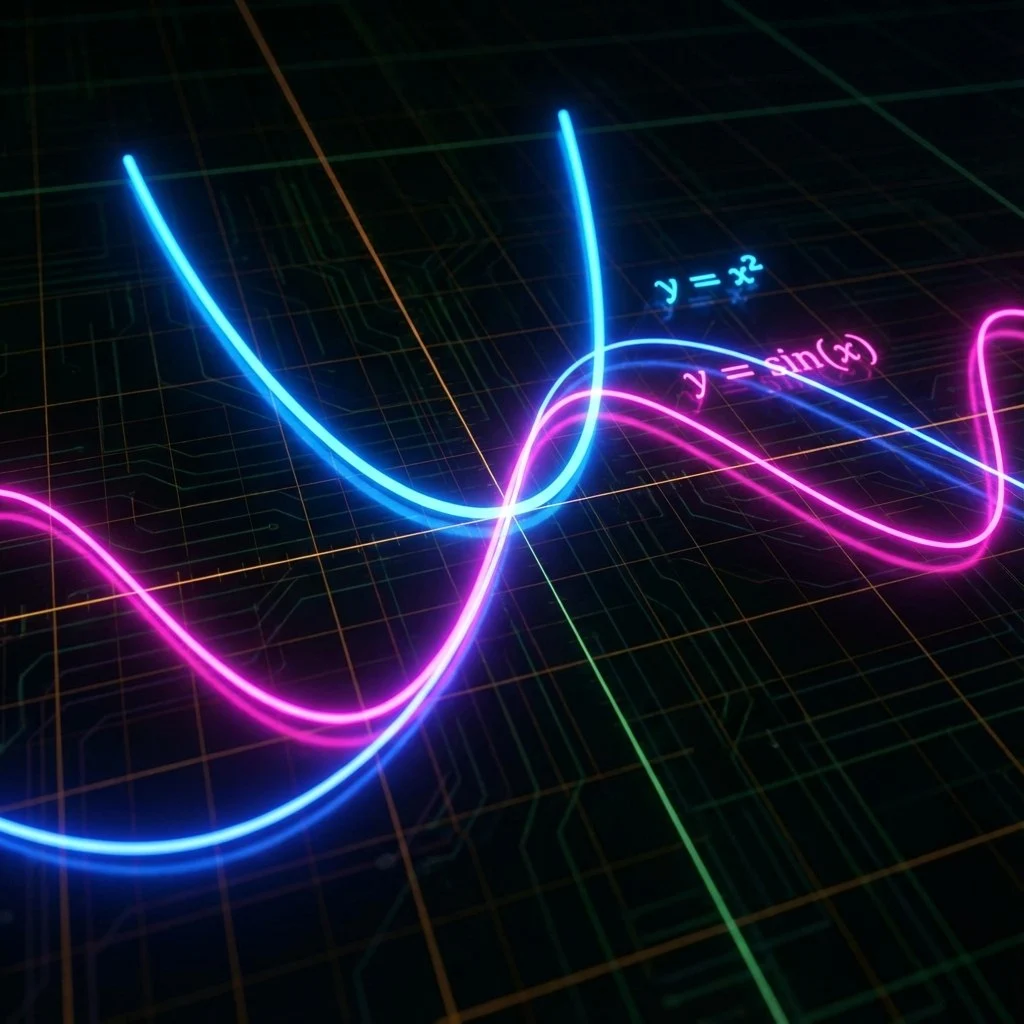
A graph turns an abstract equation into an instantly readable picture — where it peaks, where it crosses zero, where it heads to infinity — information that's hard to see from the equation alone.
2. Plain English Definition
Graphing plots the input-output pairs of a function on a coordinate plane, visually revealing its behavior across every possible input value at once.
3. Why Visualization Beats Pure Algebra
Some properties — like where a function is increasing, decreasing, or has a maximum — are tedious to find algebraically but immediately obvious on a well-drawn graph.
4. Key Terms
- X-intercept (Root): Where the graph crosses the x-axis (y = 0).
- Y-intercept: Where the graph crosses the y-axis (x = 0).
- Asymptote: A line the graph approaches but never touches.
Frequently Asked Questions
What's the difference between a root and a y-intercept?
A root is where y equals zero (the graph crosses the x-axis); a y-intercept is where x equals zero (the graph crosses the y-axis) — they answer different questions.