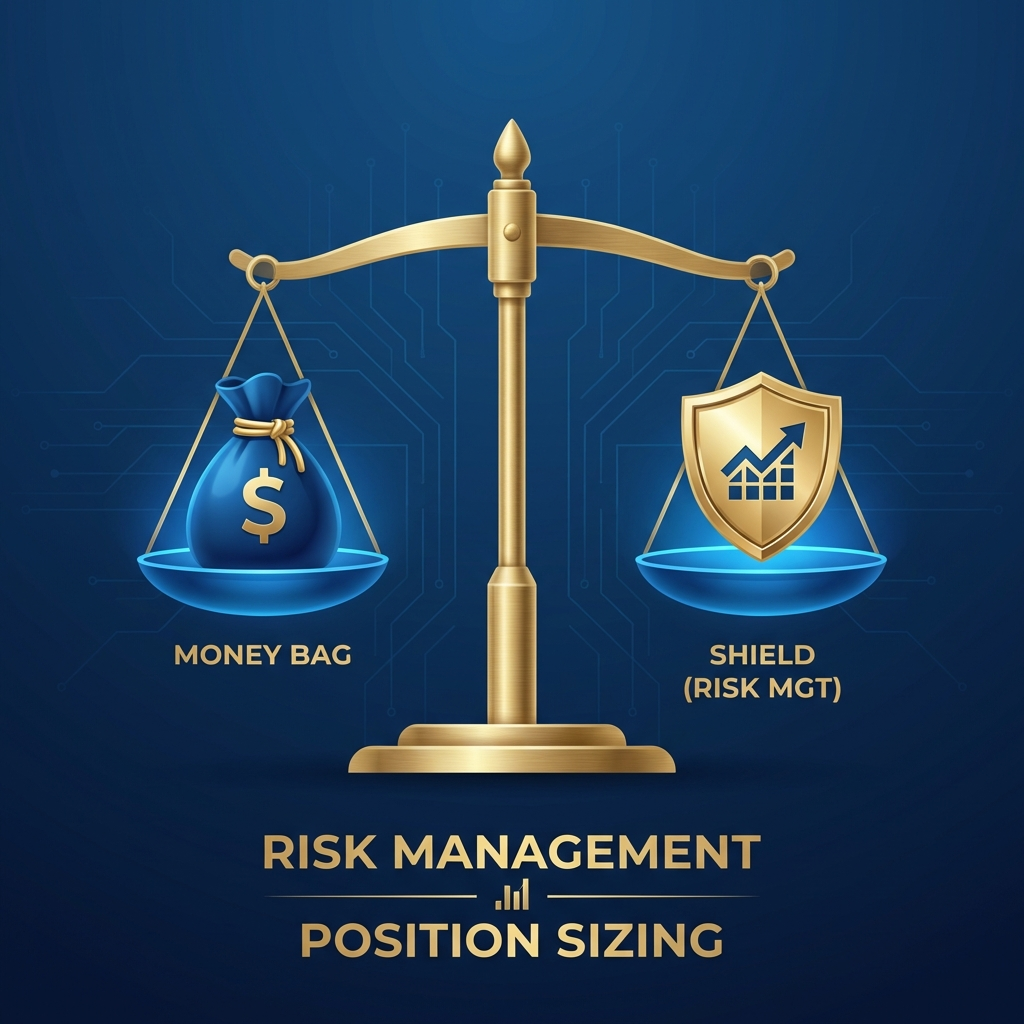
The Master Formula
Position Size (Shares) = $\frac{\text{Account Equity} \times \text{Risk \%}}{\text{Entry Price} - \text{Stop Loss Price}}$
Dimensional Analysis: Dollars vs. Percents
The numerator is Total Dollars at Risk. The denominator is Dollars at Risk per Share.Dollars / (Dollars/Share) = Shares.The math is robust. If you find yourself with a result that is a percentage, you have confused "Account Risk" with "Trade Stop %."
Variations: Sizing for Forex and Crypto
- Forex: Risk is calculated in "Pips." You must factor in the "Pip Value" for the specific currency pair.
- Crypto/Options: Because these can go to zero or gap 50% overnight, many traders use Total Notional Sizing (e.g., "I will only ever put $2,000 total into this altcoin, regardless of the stop").
Shortcuts & General Rules of Thumb
- The 2% Rule: Never risk more than 2% of your total equity on any single trade. For beginners, 0.5% or 1% is recommended.
- The "Correlation" Trap: If you buy 5 different tech stocks at 1% risk each, you are actually taking a 5% tech sector risk. If the sector crashes, all 5 stops will hit at once.
- Mnemonic: "Size for the slide, not for the pride." (Size based on the potential loss, not how much you hope to win).
Edge Cases: Gaps and Black Swans
- The Overnight Gap: If you size for a $10 loss, but the stock gaps down $20 at the open, you have lost 2% instead of 1%. This is why you should size even smaller for trades held overnight.
- Margin and Leverage: Leverage doesn't change your risk (it should stay 1%), but it allows you to take larger notional positions. Use this with extreme caution as it increases Slippage Risk.
- Low Liquidity: In small-cap stocks, your own selling might move the price. If you own 10% of the daily volume, you cannot "exit" at your stop price; you will be "slipping" much further.