Calculus

Concept Overview: The Rate of Change

Use Derivative Calculator
Concept Overview: The Rate of Change

Concept Overview: The Rate of Change

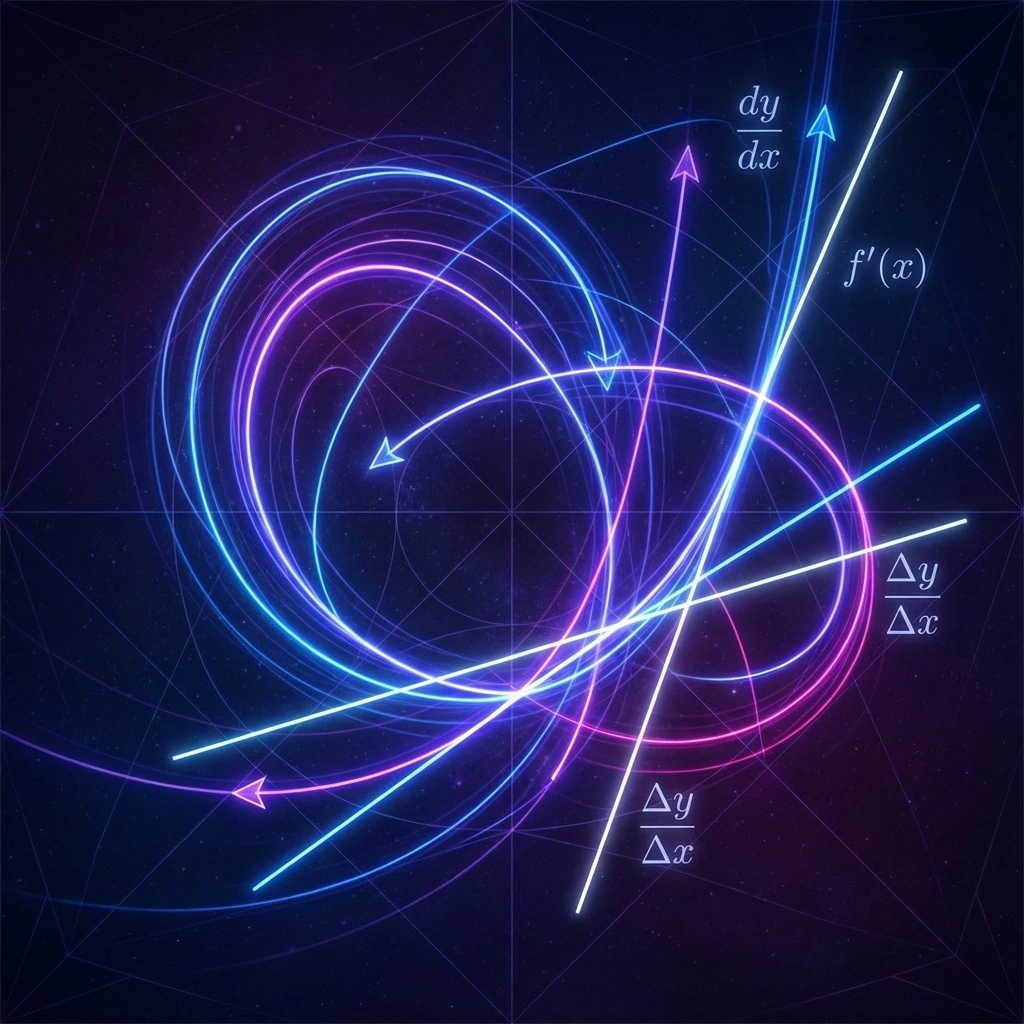
A derivative represents the sensitivity of one variable to a change in another. Mathematically, it is the slope of the tangent line to a curve at any given point. In the JEE syllabus, we transition from finding average speeds to finding instantaneous velocities. If a function $f(x)$ represents position, then $f'(x)$ represents how fast that position is shifting at a specific micro-moment in time. It is the mathematical foundation of Differential Calculus.

Real-World & Exam Relevance

Derivatives are the "engine" behind Physics and Engineering problems:

  • Kinematics (Physics): Velocity $v = dx/dt$ and Acceleration $a = dv/dt$. You cannot solve Mechanics without differentiation.
  • Maxima & Minima: Finding the highest point of a projectile or the minimum power loss in a circuit involves setting the derivative to zero.
  • Electromagnetism: Faraday’s Law ($E = -d\Phi/dt$) uses derivatives to describe how a changing magnetic field induces electricity.
  • 3D Animation: In Maya, "spline interpolation" uses derivatives to ensure that the movement of your 3D models is smooth and realistic rather than jerky.

Visualizing the Concept: The Zooming Logic

Imagine you are looking at a curved track. If you zoom in on a tiny section of that curve until it looks like a straight line, the slope of that tiny line is the derivative. In JEE terms, this is the Limit as $\Delta x$ approaches zero. It allows us to treat a complex, changing world as a series of linear approximations.

Key Terminology

  • First Principle: The definition of a derivative using limits: $f'(x) = \lim_{h \to 0} \frac{f(x+h) - f(x)}{h}$.
  • Chain Rule: The method for differentiating "nested" or composite functions.
  • Differentiability: The requirement that a graph must be "smooth" (no breaks or sharp corners) for a derivative to exist.
  • Operator: The symbol $d/dx$, which tells you to perform the action of differentiation.

Explore More Articles

Expand your knowledge with these related guides.

Concept Overview: The Relative Standing
Statistics

Concept Overview: The Relative Standing

Read Article
Concept Overview: The Reverse Gear of Calculus
Calculus

Concept Overview: The Reverse Gear of Calculus

Read Article
The Logic Behind the Math: Measuring the
Statistics

The Logic Behind the Math: Measuring the "Spread"

Read Article
Home Blog Login

Calculators

Algebra
Calculus
Statistics
Financial
Health
Favorites

Loading favorites...

Menu

About Us Request a Calculator Toggle Theme