1. The Reality Check
Your phone's GPS, video game graphics engines, and even the sound compression in your music streaming app all rely on trigonometry running invisibly in the background.
2. Plain English Definition
Trigonometry studies the relationships between the angles and sides of triangles — and by extension, the circular and wave patterns that show up throughout physics, engineering, and nature.
3. Triangles to Waves
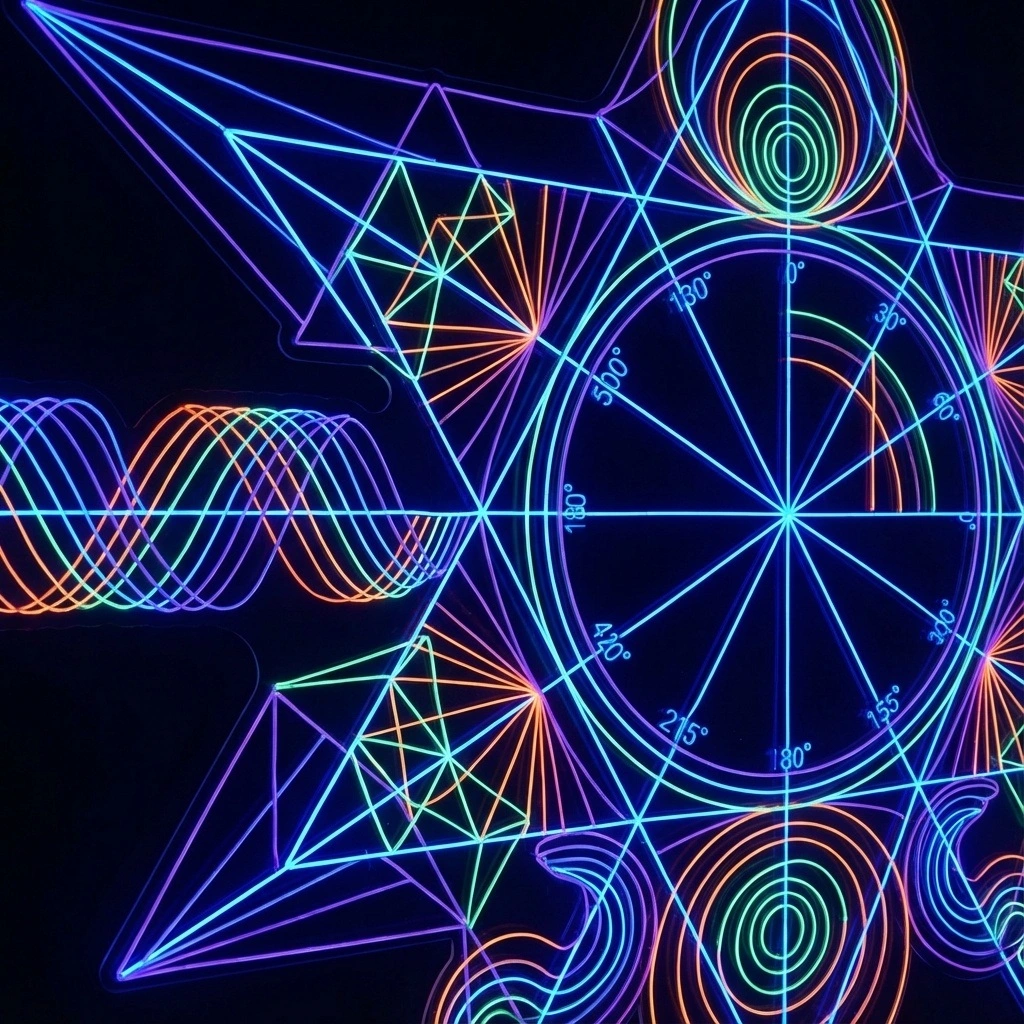
While trig starts with right triangles, its real power appears once you connect it to the unit circle — sine and cosine become the mathematical description of any repeating wave, from sound to light to alternating current.
4. Key Terms
- Sine, Cosine, Tangent: The three core ratios relating a triangle's angle to its side lengths.
- Unit Circle: A circle of radius 1 that extends trig ratios to any angle, not just those inside a triangle.
Frequently Asked Questions
Why does trigonometry matter beyond geometry class?
Any field involving rotation, oscillation, or periodic motion — sound engineering, electrical engineering, astronomy, architecture — depends on trigonometric functions.