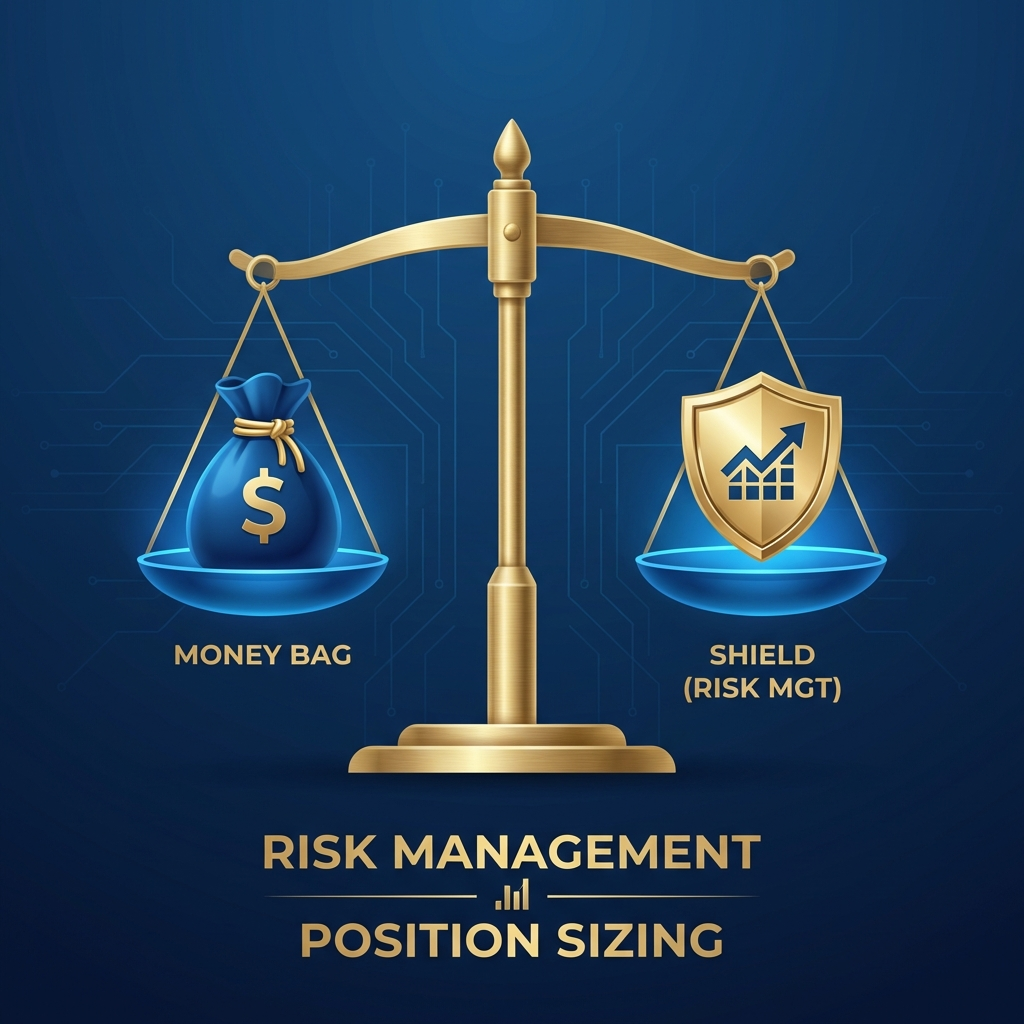
The Logic Behind the Math: Fixed Fractional Sizing
The core logic of position sizing is to make every "loss" equal in terms of dollar impact on your account, regardless of how "wide" or "tight" your stop loss is. This is known as Fixed Fractional Sizing. If you have a tight stop, you can buy more shares. If you have a wide stop (to allow a volatile stock to breathe), you must buy fewer shares. The dollar risk remains constant.
Step-by-Step Solved Trade: Sizing a Tesla (TSLA) Breakout
Scenario: A trader has a $50,000 account and wants to risk 1% of their account on a TSLA trade.
- Step 1: Calculate Dollar Risk.
$50,000 * 0.01 = $500. (This is the maximum amount the trader will lose). - Step 2: Determine Entry and Stop.Entry Price: $200. Stop Loss: $190.
- Step 3: Calculate Risk per Share.
$200 - $190 = $10 per share. - Step 4: Calculate Share Quantity.Formula:
Dollar Risk / Risk per Share.$500 / $10 = 50 shares. - Step 5: Verify Total Exposure.The total value of the trade is
50 * $200 = $10,000. This is 20% of the account value, but the risk is only 1%.
Alternative Methods: Volatility Sizing (ATR)
Some quants use the Average True Range (ATR) to size positions. Instead of an arbitrary $10 stop, they set the stop based on how much the stock typically "wiggles." This ensures that the position size is smaller for "wild" stocks and larger for "calm" stocks, normalizing the volatility across the entire portfolio.
Trader Trap Alert: The "Whole Number" Habit
A common pitfall for retail traders is buying in "Round Lots" (e.g., "I always buy 100 shares").
Quant Warning: Buying 100 shares of a $10 stock is vastly different from buying 100 shares of a $1000 stock. By using fixed share amounts, you are unintentionally taking massive risks on expensive stocks and tiny risks on cheap ones. Always calculate based on Equity Risk, never on "feel."
Practice Setup: The "Max Loss" Drill
Pick three stocks with different prices (e.g., $20, $150, and $500). Determine a 1% risk for your current account. Calculate the share size for each using a 5% stop loss. You will see how the quantity changes drastically to keep your risk identical.