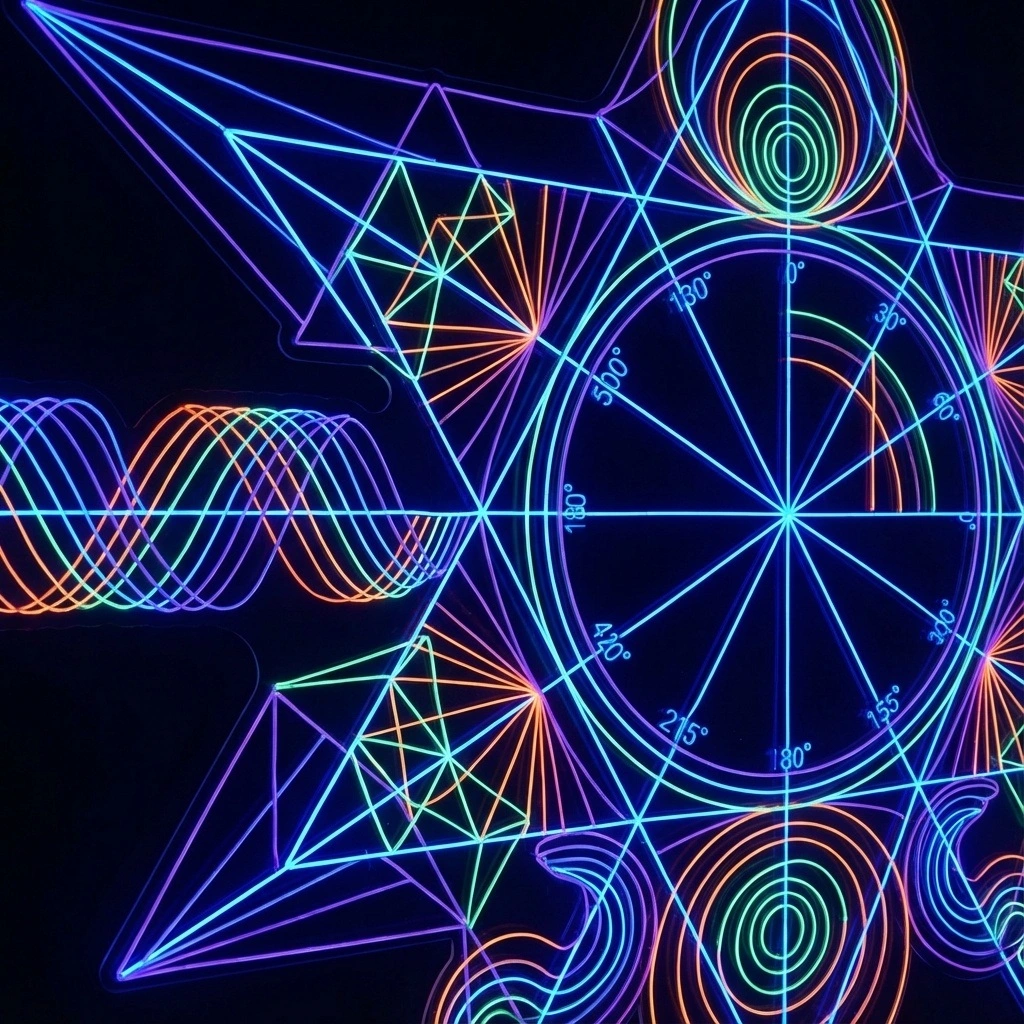
The Logic Behind the Math: The ASTC Rule
The logic for determining the sign of a trig ratio in any quadrant is governed by the ASTC Rule:
- Quadrant I (0-90°): All ratios are positive.
- Quadrant II (90-180°): Sine (and cosec) are positive.
- Quadrant III (180-270°): Tan (and cot) are positive.
- Quadrant IV (270-360°): Cosine (and sec) are positive.
Step-by-Step Solved Example (Heights & Distances)
Problem: From a point on the ground, the angle of elevation of the top of a tower is $30^\circ$. After walking 20m towards the tower, the angle becomes $60^\circ$. Find the height of the tower ($h$).
- Step 1: Set up the Triangles. Let the initial distance be $x + 20$ and the final distance be $x$.
- Step 2: Triangle 1 (Small). $\tan(60^\circ) = h/x \implies \sqrt{3} = h/x \implies x = h/\sqrt{3}$.
- Step 3: Triangle 2 (Large). $\tan(30^\circ) = h/(x + 20) \implies 1/\sqrt{3} = h/(x + 20)$.
- Step 4: Substitute $x$. $x + 20 = h\sqrt{3} \implies (h/\sqrt{3}) + 20 = h\sqrt{3}$.
- Step 5: Isolate $h$. Multiply by $\sqrt{3}$: $h + 20\sqrt{3} = 3h \implies 2h = 20\sqrt{3}$.
- Step 6: Solve. $h = 10\sqrt{3} \approx 17.32$m.
Alternative Methods: The Transformation Formula
Instead of basic ratios, JEE problems often require converting sums to products (and vice-versa).Example: $\sin C + \sin D = 2 \sin(\frac{C+D}{2}) \cos(\frac{C-D}{2})$.This "Product-to-Sum" logic is vital for simplifying complex Integrals in Calculus.
Exam Trap Alert: The Ambiguous Case
In the Sine Rule ($\frac{a}{\sin A} = \frac{b}{\sin B}$), be careful when given two sides and a non-included angle (SSA).
JEE Warning: This can result in two possible triangles, one triangle, or no triangle at all. Always check the range of $\sin \theta \in [-1, 1]$. If your calculation gives $\sin \theta > 1$, the triangle is mathematically impossible.
Practice Problem (JEE Main Level)
Question: Find the value of $\tan 15^\circ + \cot 15^\circ$.Hint: Use $\tan(45^\circ - 30^\circ)$ or convert to $\frac{\sin^2 \theta + \cos^2 \theta}{\sin \theta \cos \theta}$.