Health

Concept Overview: The Human Heat Engine

Use Calorie / TDEE Calculator
Concept Overview: The Human Heat Engine

Concept Overview: The Human Heat Engine

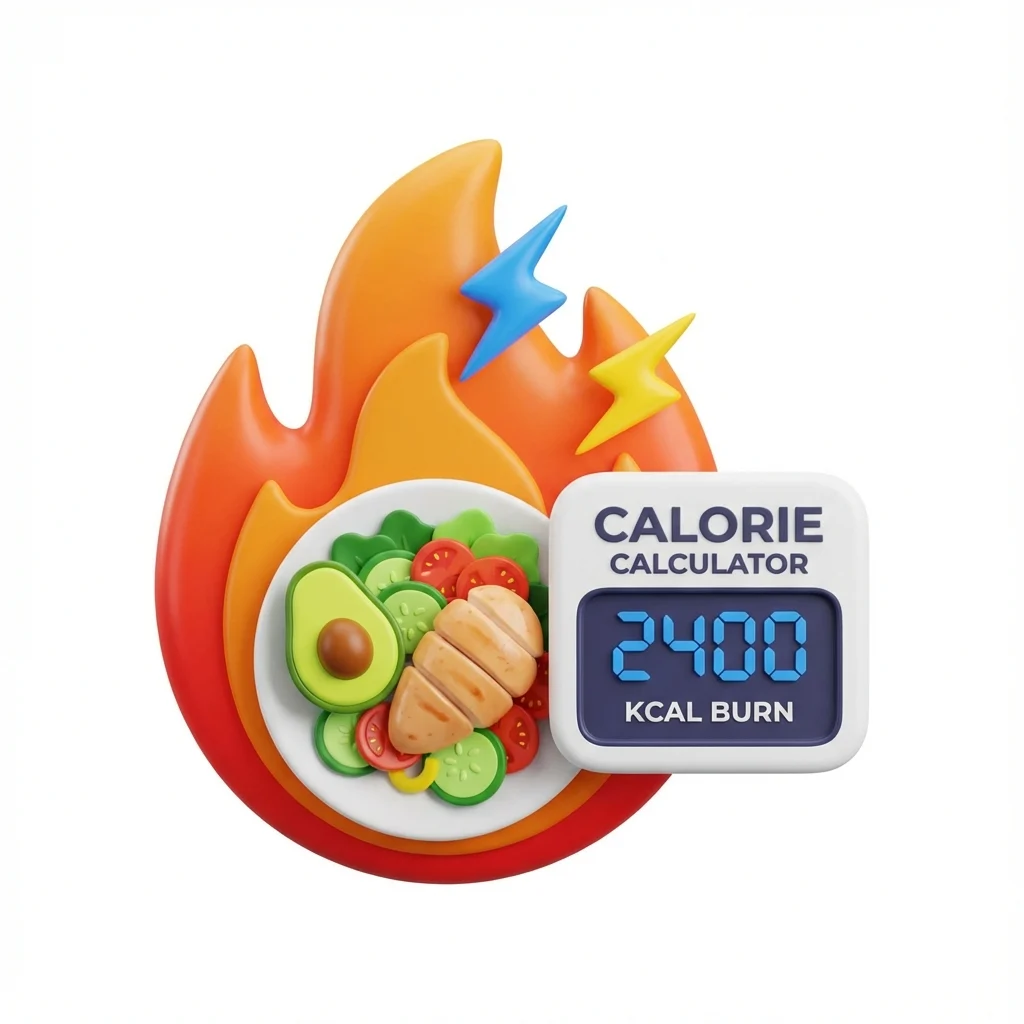
Total Daily Energy Expenditure (TDEE) is the total number of calories your body burns in a 24-hour period. In Physics terms, the human body is an Open System exchanging energy and matter with its surroundings. TDEE is the biological equivalent of the Work Output plus Internal Energy Change plus Heat Loss. For a NEET student, this connects directly to "Respiration" and "Bioenergetics," where ATP is the "currency" of this energy exchange.

Real-World & Exam Relevance

The math of TDEE and Calories is foundational to several scientific chapters:

  • Thermodynamics (Physics): The principle $\Delta U = Q - W$. If $Q$ (Caloric Intake) is greater than $TDEE$, the internal energy $\Delta U$ increases (stored as fat).
  • Calorimetry (Chemistry): The definition of a "Calorie" (the energy needed to raise 1g of water by $1^\circ C$) and the use of Bomb Calorimeters to measure the enthalpy of combustion of food.
  • Human Physiology (NEET): Understanding Basal Metabolic Rate (BMR) and its dependence on body surface area (Rubner's Law).

Visualizing the Concept: The Battery Analogy

Imagine your body is a smartphone battery.

  • BMR is the "Background Usage" (the energy needed to keep the screen on and the OS running while you aren't doing anything).
  • Activity is like running heavy apps or games.
  • TDEE is the total percentage drained by the end of the day.
To maintain a "charge" (weight), your input (food) must match the TDEE. In JEE terms, this is a Steady State problem.

Key Terminology

  • BMR (Basal Metabolic Rate): Energy spent at complete rest (Homeostasis).
  • TEF (Thermic Effect of Food): The energy "cost" of digestion (similar to Activation Energy in Chemistry).
  • NEAT: Non-Exercise Activity Thermogenesis (fidgeting, walking, etc.).
  • PAL (Physical Activity Level): A scalar multiplier applied to BMR.

Why Master This?

Understanding TDEE helps you master Multi-Variable Functions. Your energy needs depend on weight, height, age, and activity level. Learning how each variable weightage ($w_1, w_2, w_3$) affects the final output is key to understanding "Partial Derivatives" in advanced Calculus.

Explore More Articles

Expand your knowledge with these related guides.

Concept Overview: The Mathematics of Rotation
Algebra

Concept Overview: The Mathematics of Rotation

Read Article
The Logic Behind the Math: The NTA Formula
Statistics

The Logic Behind the Math: The NTA Formula

Read Article
Concept Overview: The Engine of Longevity
Education

Concept Overview: The Engine of Longevity

Read Article
Home Blog Login

Calculators

Algebra
Calculus
Statistics
Financial
Health
Favorites

Loading favorites...

Menu

About Us Request a Calculator Toggle Theme