1. The Reality Check
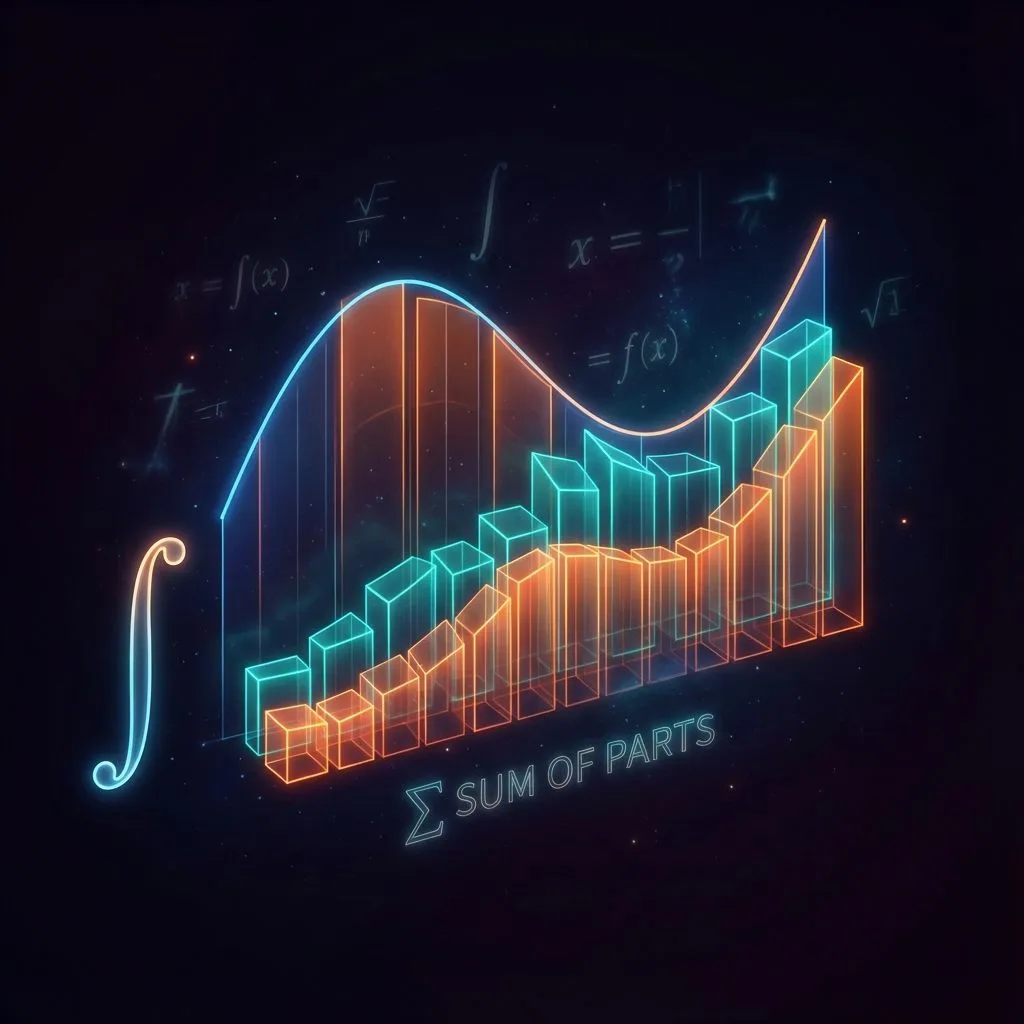
If differentiation is slicing something into infinitely thin pieces, integration is gluing those pieces back together — it's how we calculate areas, volumes, and total accumulated change.
2. Plain English Definition
Integration finds the area under a curve, or more generally, reverses the process of differentiation to recover an original function from its rate of change.
3. Definite vs. Indefinite
An indefinite integral gives a general formula (plus an unknown constant C), while a definite integral gives a specific number — the exact signed area between the curve and the x-axis over a chosen interval.
4. Key Terms
- Antiderivative: A function whose derivative matches the original function.
- + C: The constant of integration, needed because many functions share the same derivative.
Frequently Asked Questions
Why do we always add "+ C"?
Because differentiating any constant gives zero — meaning infinitely many functions share the same derivative, differing only by a constant we can't recover without more information.